[
Return to Main Page ] [
Return to Projects Index
] [
Doc's Machine & TWB Store] [
Contact Us ]
[
The Whiteboard Webcomic
]
Along with the mills themselves, Nichols also made tooling to go with those mills.
While most machines used a 1" overarm-supported arbor, they also made endmill holders,
shell mill arbors, and so on. For whatever reason, however, they made their tooling to use
a 7/16"-14 drawbar, rather than the 5/8"-11 which is now standard. I have, of course,
a mix of factory and aftermarket tooling, so I need drawbars in both sizes.
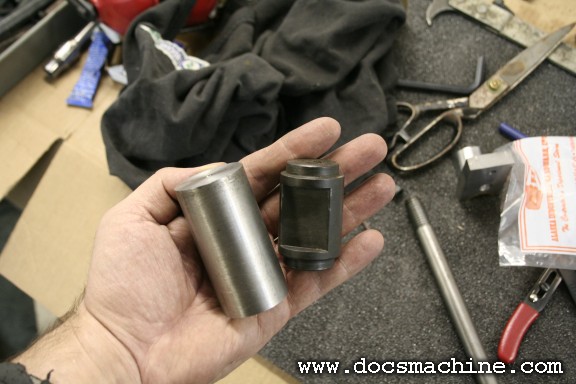
On the other hand, Nichols usually supplied the machine with a "convertible" drawbar:
the rod was threaded 7-16"" on one end, and 5/8" on the other. A "nut" with flats (shown above)
was simply switched to whichever end you weren't using, to make a complete drawbar.
Now, while this works, it was mainly designed for the mills' primary use in production.
Meaning the machine would get tooled up and set, and then would run the same part for
upwards of tens of thousands of cycles. I'll be using the mill for more prosaic one-off
shop work, so I'll be swapping tooling much more often.
To do this, I need to have better access to the wrench flats- the factory nut is somewhat
"recessed" into the drive pulley, and awkward to get a wrench on. I wanted a more
conventional hex head, like a Bridgeport, et al, for easier use.
I started with a chunk of 1-1/2" cold-rolled mild steel about 3" long...
All text, photos and graphics
Copyright 1998- 2015, Doc's Machine & Airsmith Services. All Rights
Reserved.
Information contained in
these pages is for reference and entertainment
purposes only. Our methods are not always the best,
quickest, safest, or even the correct ones. It's up to you to know how
to use your own machines and tools.
Keep your fingers away from the spinny blades o' death and you should
be all right.